

Altius Completes Challenging Multimodal Transport of Gas Compressors to Peru’s Amazon (Project RECAPEX II)
March 4, 2026
Altius SA, a Project Logistics Alliance member representing Argentina, Bolivia and Spain specializing in project cargo, has once again demonstrated its expertise in managing exceptional loads by successfully completing the RECAPEX II operation. In this project, the Altius team precisely coordinated the door-to-door transport of three gas compression units and their associated equipment from Tianjin (China) to the remote Nuevo Mundo camp in Peru’s Amazon rainforest. The complex logistics involved overcoming the absence of any road access to the destination by devising a custom multimodal route, surmounting multiple infrastructure challenges to meet the client’s deadlines and technical requirements.
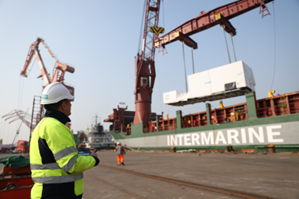
The shipment comprised components for a natural gas compression plant, including three booster compressors mounted on large steel skids, their three drive motors, and three gas aerial coolers, along with numerous structural frames, pipelines, and accessories. In total, 41 project cargo units were moved, with a combined volume of approximately 1,463 m³ and a total weight of about 1,009 metric tons. The single heaviest item was the main compressor skid (3x units), measuring roughly 12.5 × 4.82 × 3.50 m and weighing ~97 tons, underscoring the magnitude of the equipment involved. Given these extraordinary dimensions and weights (many pieces weighing tens of tons each), no component could be shipped in standard containers; all cargo traveled as breakbulk, requiring specialized handling and transport methods typical of an out-of-gauge heavy-lift project.
(Picture Credit: Altius)
To bridge the gap between origin and destination, Altius implemented a carefully planned multimodal route combining ocean and river transport. First, a dedicated project cargo vessel, the M/V Industrial Dart, was chartered for a direct, non-stop voyage from Tianjin to Peru via the Panama Canal. This intercontinental leg spanned roughly 50 days, with the vessel arriving at the mouth of the Amazon River in late December 2025. Because the final destination has no seaport or road connectivity, the operation then shifted to the Amazon’s inland waterways for the final stretch.
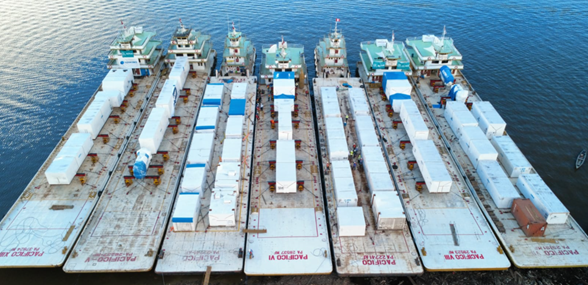
Upon reaching Peru, the ocean vessel anchored near Iquitos, where all 41 cargo units were transshipped to smaller river barges. In total, seven (7) river barges (accompanied by tugboats) were deployed to navigate approximately 1,500 km upstream along the Amazon, Ucayali, and Urubamba rivers, ferrying the cargo in stages to Nuevo Mundo. Depending on each piece’s characteristics, Altius employed a mix of Roll-On/Roll-Off (Ro-Ro) techniques – rolling the heaviest modules directly onto barges – and Lift-On/Lift-Off (Lo-Lo) crane operations for others. The transport sequence included four Ro-Ro shipments, one combined Ro-Ro/Lo-Lo shipment, and two Lo-Lo shipments, optimized for safety and efficiency. This arduous upriver journey was completed in about 28 days, including unloading time, with staggered barge arrivals at the project’s river jetty through January 2026. All equipment was successfully offloaded at Nuevo Mundo by February 5, 2026, marking the successful conclusion of the logistic operation.
 (Picture Credit: Altius)
The successful execution of Project RECAPEX II required meticulous planning and international coordination. Altius served as the integral logistics operator, managing every phase of the door-to-door journey. Responsibilities included preparations at origin in China – supervising the disassembly of equipment, packaging and labeling of all units, port operations in Tianjin (cargo stowage and lashing aboard the vessel), and arranging full cargo insurance. During the ocean transit, the team chartered a vessel for the Tianjin–Iquitos route, performed technical inspections and detailed stowage planning, and monitored the ship’s position daily to maintain schedule adherence.
Before the cargo’s arrival in Peru, several pre-operational measures were implemented: Altius coordinated a pre-clearance of import documentation with Peruvian customs to expedite the Iquitos port discharge, fabricated steel beams and supports (stools) to reinforce the barges for heavy loads, developed barge-specific stowage plans, and secured a designated anchorage area in Iquitos for safe transshipment. The team also verified the viability of navigating the Amazon route by confirming river depths and obtaining necessary permits for the sea-to-river transition, ensuring the ocean vessel could enter the Amazon safely.
(Picture Credit: Altius)
Throughout the inland river transit, Altius oversaw rigorous cargo lashing (securing) procedures and conducted en-route inspections at key waypoints (Iquitos, Pucallpa, and Atalaya) to ensure all items remained securely fastened during movement. Following a carefully planned delivery sequence, the barge convoys delivered all components to site according to project priorities, while Altius managed the required documentation and orchestrated the final unloading at Nuevo Mundo without incident.

(Picture Credit: Altius)
This project underscores Altius’s capability to handle oversized logistics under extremely challenging conditions. Through proactive coordination, detailed route engineering, and expert execution, the company delivered a seamless solution despite the operation’s complexity. RECAPEX II concluded successfully, reinforcing Altius’s reputation as a reliable partner for specialized heavy-cargo projects in the region.


